
AMPL is a production-grade optimization platform used by leading organizations in energy, finance, logistics, and advanced analytics to solve large-scale decision problems with speed, flexibility, and long-term stability.
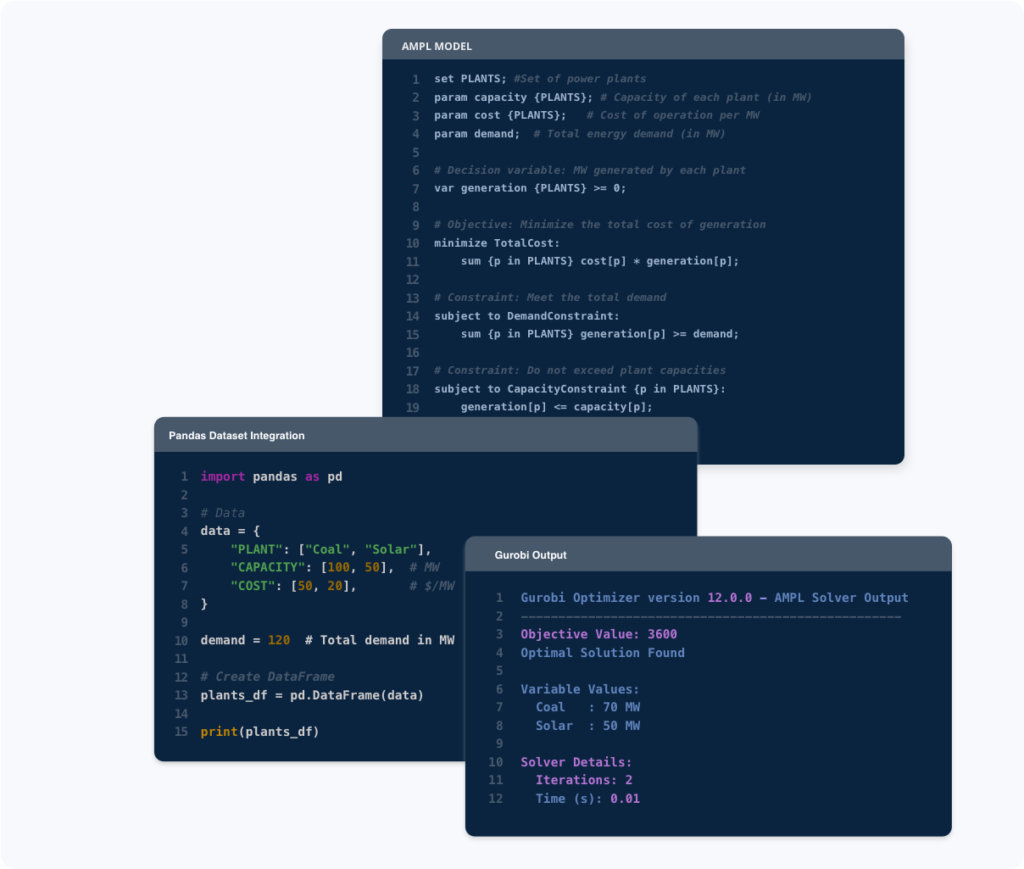
Large-scale optimization rarely lives in a single model or a single solver. It involves millions of variables, nonlinear and discrete constraints, evolving business logic, and integration into operational systems.
AMPL was designed for this level of complexity – separating model structure from data, enabling solver flexibility, and supporting reliable production deployment.
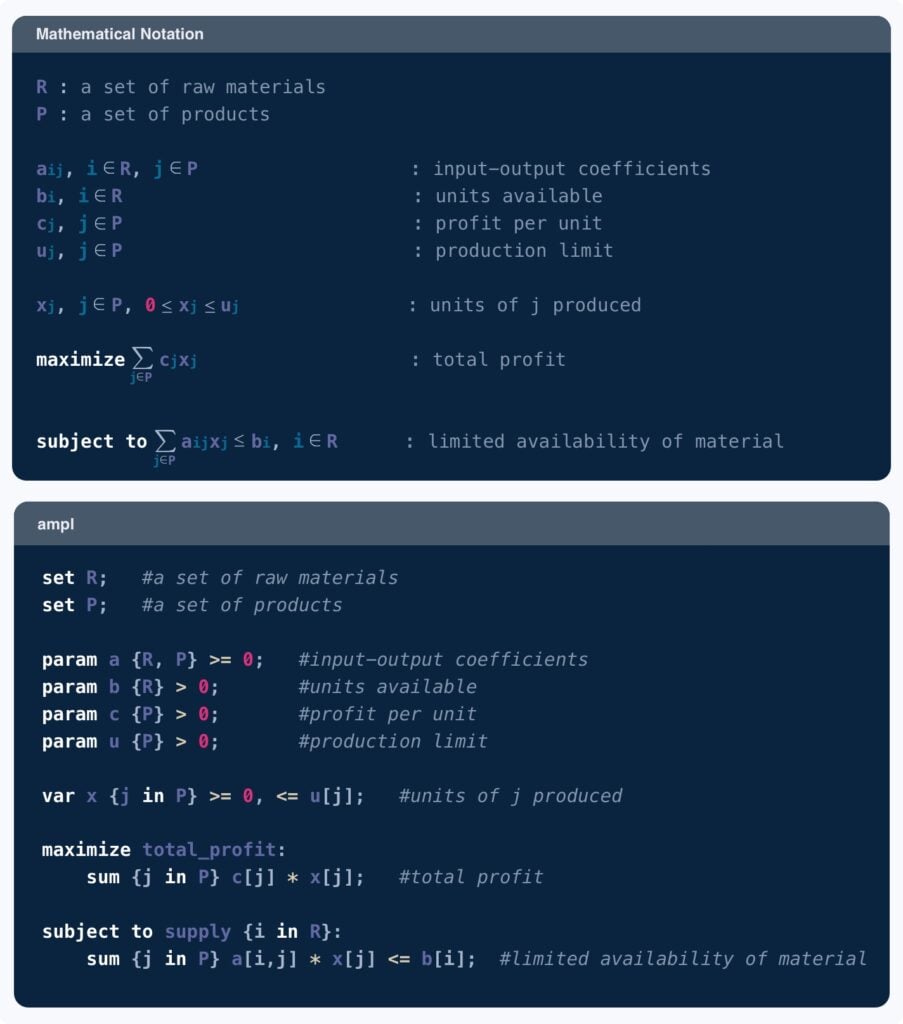
Express optimization problems in algebraic form that mirrors the mathematics. Maintain clean separation between model logic and data for long-term scalability and auditability.
Through its MP interface, AMPL interoperates with leading linear, nonlinear, mixed-integer, and global solvers, protecting your investment and avoiding vendor lock-in.
Develop in VS Code. Connect via APIs. Deploy alongside Python, analytics pipelines, and enterprise infrastructure without embedding optimization logic in application code.
Versioned models, reproducible runs, enterprise licensing, and operational stability, designed for systems that stay in production.
AMPL is a domain-specific language designed exclusively for mathematical optimization.
While general programming languages manage application logic and data processing, AMPL focuses on expressing optimization models clearly and rigorously. It enables teams to formulate complex problems using algebraic notation that mirrors the underlying mathematics — improving clarity, scalability, and long-term maintainability.
AMPL’s syntax reflects mathematical form directly. Models remain concise, interpretable, and easier to audit, even as they grow in size and complexity.
AMPL enforces a clean separation between model structure and input data. This architecture:
AMPL supports linear, nonlinear, mixed-integer, and global optimization models through its unified solver interface. Teams can develop a single model structure and deploy it across different solver technologies without rewriting core logic.
AMPL MP provides a solver interface designed for today’s commercial and nonlinear solvers. It performs automatic reformulation, constraint translation, and solver-aware preprocessing so models can fully exploit advanced solver features.
For complex MINLP, nonlinear, or large-scale systems, MP improves reliability without increasing model complexity.
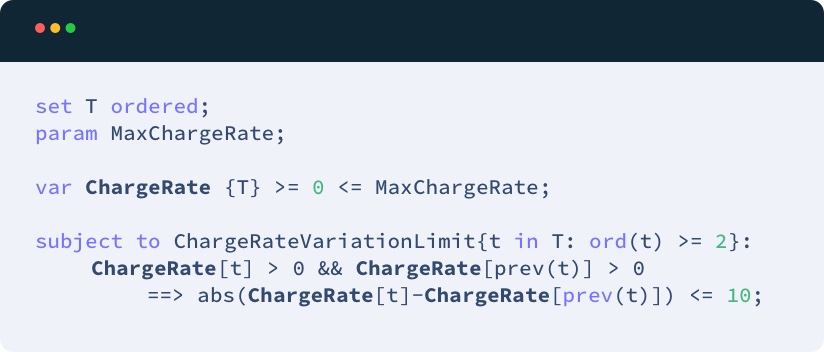
MP translates high-level algebraic expressions into forms optimized for each solver, allowing teams to benefit from advanced features without restructuring models.
Move between supported solvers without rewriting model logic — protecting long-term investments and avoiding vendor lock-in.
Automatic reformulations reduce solver friction in complex MINLP and nonlinear systems.
AMPL models express optimization problems in algebraic form that mirrors the underlying mathematics.
MP extends this foundation, enhancing solver interaction without increasing model complexity.
AMPL MP supports:
MP is not an experimental layer. It is designed for optimization systems that stay in production.
The AMPL MP documentation outlines supported solver interfaces, reformulation behavior, and advanced constraint handling. Worked examples illustrate nonlinear, mixed-integer, and large-scale use cases, showing how MP preserves model clarity while enabling solver-specific performance improvements.
AMPL integrates into modern engineering environments without requiring teams to redesign their systems. It works alongside your data pipelines, application layer, and solver infrastructure.
You keep your stack. AMPL handles the optimization layer.
AMPL integrates with Visual Studio Code for structured model development, version control, and collaboration.
AMPL can be embedded into applications, services, and backend systems through modern APIs.
Optimization becomes a callable component inside your system, not a standalone tool.
AMPL works with structured data sources and existing infrastructure:
Models remain clean and independent from data sources, enabling scalable architecture and easier maintenance over time.
AMPL connects to commercial and open-source solvers through a unified interface.
This flexibility protects long-term investments and allows teams to choose the right solver for each deployment scenario.
Complementary by Design
AMPL is purpose-built for mathematical modeling.
Python is widely used for application logic, data processing, and system orchestration.
In production environments, they serve different roles.
Using amplpy, optimization becomes a callable component inside a Python-based system — without embedding model logic directly into application code.
This separation allows teams to:
AMPL does not replace Python.
It strengthens optimization within a Python-based architecture.
Optimization systems require more than software. They require domain understanding, solver expertise, and long-term technical support.
AMPL provides structured services for teams deploying optimization in production environments.

AMPL supports teams building large-scale, high-stakes optimization systems across energy, finance, logistics, and advanced analytics.
Access free licenses today and explore production-grade optimization capabilities.
